
Geographic Tongue

Disclaimer: Disclaimer: This leaflet provides general information and is intended for educational purposes only. It should not be used as a substitute for professional medical advice, diagnosis, or treatment. Always seek the advice of a qualified healthcare professional for any health concerns or before making any decisions related to your health or treatment.
This leaflet may contain links to external websites or resources (e.g. YouTube) for demonstration purposes; however, these links are provided for information only. Clinicol.co.uk is not affiliated with, does not endorse, and is not responsible for the content, accuracy, or copyright compliance of these external sources. Use of these external links is at your own discretion and risk.
Overview
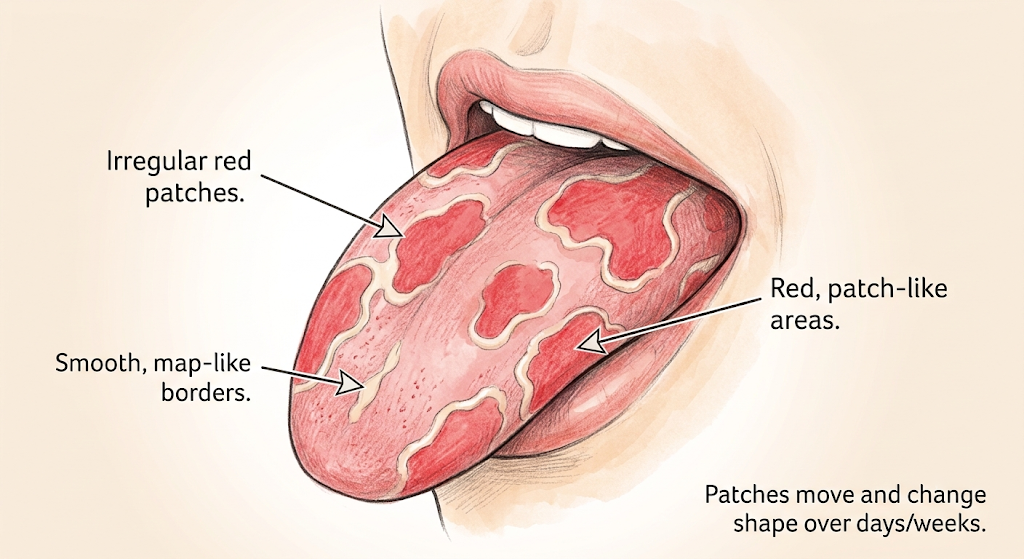
Geographic tongue, also known by its medical names benign migratory glossitis or erythema migrans, is a common and completely harmless condition that affects the surface of your tongue. It's not serious, it's not cancerous, and it doesn't pose any risk to your long-term health.
If you have geographic tongue, you'll notice distinctive red, smooth patches on your tongue. These patches often have pale or white borders, giving them a unique, map-like appearance. What's particularly interesting about these patches is that they can change in size and move around your tongue over a period of days or weeks. They might appear on the top surface, the sides, and occasionally even the underside of your tongue.
This condition is quite common, affecting about 1 to 3 out of every 100 people. It can occur at any age, sometimes even being noticed in infancy. It's important to understand that geographic tongue is not an infection, which means it cannot be passed on to other people.
Symptoms and Causes
Understanding why geographic tongue occurs and what it looks like can help you manage the condition effectively. While it often doesn't cause any trouble, some people do experience discomfort.
Symptoms
The main symptom of geographic tongue is its distinctive appearance. You might notice:
- Map-like patches: These are irregular, smooth, red areas on your tongue, surrounded by wavy white or light-coloured borders. They truly resemble a small map.
- Changing patterns: The patches are not static; they can vary in size and move across different parts of your tongue over days, weeks, or even months.
- Location: While most commonly seen on the upper surface, these patches can also appear on the sides and, less often, the underside of your tongue.
- Cracks or fissures: Sometimes, you might also notice small cracks or grooves on your tongue alongside the patches.
- Soreness or sensitivity: Many people with geographic tongue don't feel any pain at all. However, some individuals experience soreness, a burning sensation, or increased sensitivity. This discomfort is often triggered or made worse by certain foods and drinks, such as those that are spicy, acidic, hot, citrusy, vinegary, or salty.
- Increased risk of thrush: Occasionally, the areas affected by geographic tongue can become more prone to developing oral thrush, which is a common fungal infection. If this happens, it can lead to additional inflammation and soreness.
Causes
The exact reason why geographic tongue develops is still unknown. However, medical experts consider it to be a normal variation in the appearance of the tongue, rather than a disease in the traditional sense. It's not caused by an infection, and it's not something you can catch or pass on to others.
It's thought that geographic tongue might be related to how the surface of your tongue renews itself. In certain areas, the outer layer of the tongue may shed faster than usual, leaving behind the smooth, red patches you see.
While the precise cause remains a mystery, several factors are often associated with geographic tongue:
- Family tendency: The condition can sometimes run in families, suggesting there might be a genetic link, although this isn't fully understood.
- Allergies and sensitivities: Geographic tongue is more common in people who have other environmental sensitivities or allergies, such as eczema, asthma, or contact skin allergies. It's also sometimes linked with psoriasis, a skin condition.
- Fissured tongue: It's quite common for people with geographic tongue to also have a fissured tongue, which means their tongue has deep grooves or furrows.
Although these factors are associated, they don't directly cause the condition. Instead, certain things can act as triggers, making the symptoms worse or causing a flare-up:
- Irritating foods and drinks: Spicy, hot, citrus, vinegary, or salty foods are common culprits. Strong alcoholic drinks can also irritate the tongue.
- Oral hygiene products: Some strong mouthwashes that contain alcohol can cause stinging. Similarly, toothpastes containing sodium lauryl sulfate (SLS) can sometimes irritate sensitive tongues.
- Smoking and alcohol: Reducing or avoiding smoking and limiting alcohol intake can help, as these can worsen symptoms.
- Stress or illness: Periods of stress or general illness can sometimes trigger a flare-up of geographic tongue.
- Physical irritation: Sharp edges on teeth or rough fillings can rub against the tongue and cause irritation, potentially making geographic tongue symptoms more noticeable.
Diagnosis and Investigations
If you're concerned about changes on your tongue, it's always a good idea to speak to a healthcare professional. Diagnosing geographic tongue is usually a straightforward process.
Diagnosis
A diagnosis of geographic tongue is typically made by a dentist, your GP, or an oral specialist. They will usually diagnose the condition based on two main things:
- Visual appearance: The distinctive map-like patches with their red, smooth centres and white borders are usually very clear and unique to geographic tongue.
- Patient history: They will ask you about your symptoms, such as whether you experience soreness or sensitivity, what foods or drinks seem to trigger discomfort, and how long you've noticed the patches.
Because the appearance is so characteristic, specific tests are usually not needed to confirm a diagnosis of geographic tongue. Sometimes, if the patches are not visible during your appointment, taking a photograph of your tongue when the patches are present can be very helpful for your doctor or dentist.
Investigations
While most cases of geographic tongue don't require any special investigations, there are a few situations where your doctor or dentist might suggest some tests:
- To rule out fungal infections: If your symptoms include significant inflammation or soreness, and especially if they suggest oral thrush, your doctor might take a swab or prescribe anti-fungal medication to see if that helps.
- To check for nutritional deficiencies: Very occasionally, a blood test might be conducted. This is usually done to check for conditions like anaemia (a lack of iron in the blood) or a zinc deficiency, as these can sometimes affect the health of your mouth and tongue. However, this is not a routine test for geographic tongue itself.
It's important to remember that these investigations are generally to rule out other conditions that might have similar symptoms or to address any secondary issues, rather than to diagnose geographic tongue directly.
Management and Treatment
There is no specific cure for geographic tongue, as it's a harmless condition rather than a disease. However, if you experience discomfort or soreness, there are many effective ways to manage your symptoms and improve your quality of life.
The main focus of treatment is to reduce any discomfort and avoid things that trigger flare-ups:
- Identify and avoid irritants: This is often the most important step. Pay close attention to what makes your tongue feel worse. Common irritants include:
- Foods: Spicy, hot, acidic (like citrus fruits or tomatoes), vinegary, or salty foods.
- Drinks: Strong alcoholic beverages.
- Oral hygiene products: Mouthwashes that contain alcohol can sting. If you find your toothpaste causes irritation, try switching to a mild, alcohol-free mouthwash and an SLS-free (sodium lauryl sulfate-free) toothpaste.
- Smoking: Reducing or stopping smoking can significantly help, as it can worsen symptoms.
- Alcohol: Limiting your alcohol intake to recommended levels can also be beneficial.
- Food diary: Keeping a simple diary of what you eat and drink, and how your tongue feels afterwards, can help you pinpoint your specific triggers.
- Maintain good oral hygiene: Regular and gentle brushing of your teeth and tongue is important for overall oral health.
- Regular dental check-ups: Your dentist can check for and smooth out any sharp edges on your teeth or fix broken fillings that might be rubbing against and irritating your tongue.
- Over-the-counter symptom relief:
- Numbing mouthwashes or sprays: Products like Difflam or Gengigel can be very helpful. They contain ingredients that temporarily numb the sore areas of your tongue. You can use these before and after eating to make meals more comfortable. However, it's best to use them for short periods, as very long-term use might sometimes cause irritation.
- Painkillers: Simple over-the-counter painkillers, such as paracetamol or ibuprofen, can help manage any general pain or soreness.
- Prescribed medications for severe cases:
- Simple mouthwashes: Your doctor or dentist might prescribe a specific simple mouthwash to help soothe your tongue.
- Steroid mouthwash: In more severe cases, where soreness and inflammation are significant, a doctor might prescribe a steroid mouthwash. This helps to reduce the inflammation and discomfort, but it's important to remember it's not a cure for the condition itself.
- Anti-fungal medication: If your geographic tongue has made you more prone to oral thrush, and you develop symptoms of a fungal infection, your doctor can prescribe anti-fungal medication to clear it up.
Prevention
Since the exact cause of geographic tongue isn't fully understood, there isn't a way to completely prevent the condition from appearing in the first place. However, you can take several steps to prevent or reduce the frequency and severity of flare-ups and manage any symptoms you experience:
- Be aware of your triggers: The most effective way to prevent flare-ups is to identify what makes your geographic tongue worse and then avoid those specific irritants. This includes certain foods (spicy, acidic, hot, citrus, vinegary, salty), strong alcoholic drinks, and some oral hygiene products (alcohol-containing mouthwashes, SLS-based toothpastes if they cause stinging). Keeping a food diary can be a very useful tool for this.
- Maintain excellent oral hygiene: Brush your teeth gently and regularly. Good overall mouth health can help reduce general irritation.
- Attend regular dental check-ups: Your dentist can spot and address any potential sources of irritation in your mouth, such as sharp edges on teeth or rough fillings, which could be contributing to your tongue's discomfort.
- Reduce smoking and alcohol intake: Both smoking and excessive alcohol consumption can irritate the tongue and worsen the symptoms of geographic tongue. Cutting down or stopping these habits can lead to an improvement.
- Manage stress: While not a direct cause, stress and general illness can sometimes act as triggers for flare-ups. Finding ways to manage stress, such as relaxation techniques, can be beneficial for your overall health and potentially for your geographic tongue.
Outlook / Prognosis
Geographic tongue is a very common, benign (which means harmless), and non-cancerous condition. It is not considered serious and does not increase your risk of developing oral cancer or any other serious health problems.
For most people, geographic tongue is a long-term condition. This means it often has periods where the patches are very noticeable and symptoms might flare up, followed by quieter times when your tongue looks and feels more normal. The characteristic map-like patches can change their position and appearance over days, weeks, or months, which is a normal part of the condition.
While there isn't a cure, geographic tongue is very manageable. By understanding your personal triggers and using the various management strategies, such as avoiding irritating foods and using numbing mouthwashes when needed, most people can live comfortably with the condition. It may persist for many years, or even a lifetime, but for some individuals, it might improve over time or even disappear completely on its own.
The main challenge of geographic tongue is the potential for discomfort or soreness, especially when eating certain foods. Occasionally, the affected areas of the tongue might become more susceptible to oral thrush, a common fungal infection. If this happens, it can be easily treated with anti-fungal medication prescribed by your doctor or dentist.
It's important to remember that geographic tongue itself does not lead to serious complications. However, you should always seek further advice from your dentist or GP if:
- The pain or soreness on your tongue persists despite you avoiding triggers and trying simple remedies.
- You notice a single ulcer or lump on your tongue or anywhere else in your mouth that does not heal after 2 to 3 weeks.
- You experience any other new or concerning changes in your mouth or your general health.
Regular dental check-ups are always recommended to monitor your oral health and provide reassurance.
Need Expert Advice?
Book a consultation with Mr Ahmad Hariri to discuss your symptoms and treatment options.
Book a Consultation