
Hypopharyngeal Cancer

Disclaimer: Disclaimer: This leaflet provides general information and is intended for educational purposes only. It should not be used as a substitute for professional medical advice, diagnosis, or treatment. Always seek the advice of a qualified healthcare professional for any health concerns or before making any decisions related to your health or treatment.
This leaflet may contain links to external websites or resources (e.g. YouTube) for demonstration purposes; however, these links are provided for information only. Clinicol.co.uk is not affiliated with, does not endorse, and is not responsible for the content, accuracy, or copyright compliance of these external sources. Use of these external links is at your own discretion and risk.
Overview
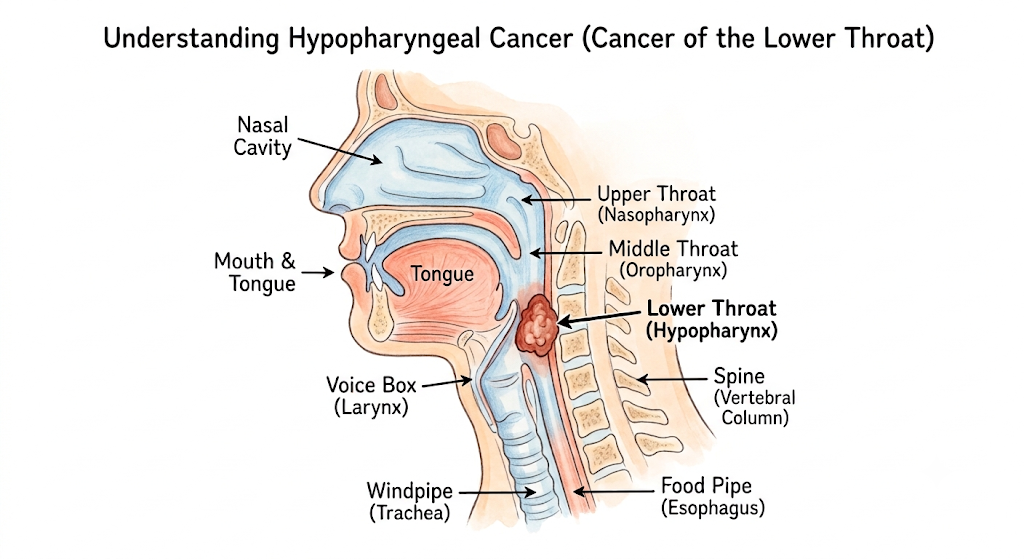
This condition is a rare type of cancer that develops in the hypopharynx. The hypopharynx is the bottom part of your throat, located just behind the voice box (larynx) and leading into the food pipe (oesophagus). It acts as a gateway for both the air you breathe and the food you swallow. Because this area is tucked away and hidden from view, cancers here are often not found until they have reached a more advanced stage.
This type of cancer is a form of squamous cell carcinoma, which means it starts in the flat, thin cells that line the inside of the throat. While it is an aggressive condition, medical teams are highly experienced in managing it through a combination of treatments. It affects people differently, and your care will be tailored specifically to your needs by a team of specialists working together to provide the best possible support and treatment plan.
Symptoms and Causes
Understanding why this condition develops and what signs to look for is an important step in your care. Because the hypopharynx is involved in both breathing and swallowing, changes in these functions are often the first clues that something is wrong.
Symptoms
Symptoms can sometimes be subtle at first, but they tend to become more noticeable over time. Common signs include:
- A lump in the neck: You might feel a new or growing swelling in your neck area.
- Persistent sore throat: A throat ache that does not go away after a few weeks.
- Referred ear pain: Sometimes, pain from the throat can be felt in the ear, even if there is nothing wrong with the ear itself.
- Difficulty swallowing: You may feel like food is getting stuck or find it increasingly hard to swallow, which can lead to unintended weight loss.
- Hoarseness: Changes to your voice, such as a persistent raspiness or breathiness, especially if the cancer affects the nearby voice box.
- Breathing difficulties: In later stages, if the tumour grows large enough, it may partially block the airway, making it feel harder to breathe.
Causes
While it is not always clear why one person develops this cancer and another does not, certain habits and lifestyle factors are known to increase the risk significantly. The most prominent factors include:
- Tobacco use: Smoking cigarettes, cigars, or pipes is a major risk factor.
- Alcohol consumption: Regularly drinking large amounts of alcohol, especially when combined with smoking, significantly raises the risk.
- Dietary factors: An unhealthy diet that lacks essential nutrients can also play a role in the health of the throat lining.
Diagnosis and Investigations
If you have symptoms that concern you, your doctor will want to take a close look at your throat to understand what is happening. This process is thorough to ensure that any treatment plan is based on the most accurate information possible.
Diagnosis
The diagnostic process begins with a conversation about your medical history and a physical examination. A specialist will carefully feel your neck for any lumps or swollen lymph nodes. They will also look inside your throat using a small, flexible camera to get a clear view of the area. This helps the team see if there are any visible growths or areas of irritation that need further investigation.
Investigations
To get a complete picture, several tests are usually required:
- Rigid endoscopy: This is a procedure performed under a general anaesthetic (where you are put to sleep) to allow the surgeon to examine the throat in great detail and take small tissue samples, known as a biopsy, for testing.
- Cross-sectional imaging: You will likely have a CT scan (a detailed 3D X-ray) of your head, neck, and chest. Sometimes, an MRI scan (which uses magnets to create detailed images) is used to look more closely at the primary site of the tumour.
- PET-CT scans: This is a special type of scan that uses a mild radioactive tracer to highlight areas of high activity in the body, which helps the team see if the cancer has spread.
Management and Treatment
Treatment for this condition is managed by a multidisciplinary team—a group of different specialists, such as surgeons, oncologists (cancer doctors), and speech therapists, who work together. The goal is to remove or shrink the cancer while preserving as much function as possible.
For early-stage cancers, treatment might involve a single approach, such as surgery or radiotherapy (using high-energy rays to kill cancer cells). Surgeons may use transoral techniques, which involve operating through the mouth using lasers or robotic tools to remove the tumour without needing an external cut on the neck.
For more advanced cases, a combination of treatments is often necessary. This might include:
- Chemotherapy: Using medicines to kill cancer cells, often given alongside radiotherapy.
- Extensive surgery: In some cases, it may be necessary to remove part or all of the voice box and the surrounding throat tissue. If this happens, a permanent opening in the neck, called a stoma, is created to allow you to breathe. Your team will provide extensive support to help you adapt to this and will work with you to restore your voice function.
- Immunotherapy: In specific situations where the cancer has returned or spread, newer treatments that help your own immune system fight the cancer cells may be used.
Prevention
While not all cases can be prevented, you can take positive steps to reduce your risk. The most effective way to protect your throat health is to avoid tobacco products entirely. Limiting your alcohol intake is also a very important step. Eating a balanced, healthy diet rich in fruits and vegetables supports your body’s overall health and may help protect the cells in your throat. If you are concerned about your risk, speaking with your GP about support to stop smoking or reduce alcohol consumption is a proactive way to look after your long-term health.
Outlook / Prognosis
The outlook for this condition depends on how early it is found and the specific characteristics of the tumour. When caught at an early stage, the chances of successful treatment are much higher. Because this condition is aggressive, it is common for the medical team to monitor you very closely for at least two years after your treatment finishes, as this is when the risk of the cancer returning is highest.
Living with or after this cancer can be a significant journey. Many people find that their daily life changes, particularly regarding how they eat, speak, or breathe. You will have access to a dedicated team of professionals, including speech and language therapists and dietitians, who will help you manage these changes. Even after treatment, the goal is to ensure you have the best possible quality of life. If the cancer is not treated, it can cause severe pain, difficulty breathing, and an inability to swallow, which is why early detection and following your treatment plan are so vital.
Need Expert Advice?
Book a consultation with Mr Ahmad Hariri to discuss your symptoms and treatment options.
Book a Consultation