
Laryngeal Cancer

Disclaimer: Disclaimer: This leaflet provides general information and is intended for educational purposes only. It should not be used as a substitute for professional medical advice, diagnosis, or treatment. Always seek the advice of a qualified healthcare professional for any health concerns or before making any decisions related to your health or treatment.
This leaflet may contain links to external websites or resources (e.g. YouTube) for demonstration purposes; however, these links are provided for information only. Clinicol.co.uk is not affiliated with, does not endorse, and is not responsible for the content, accuracy, or copyright compliance of these external sources. Use of these external links is at your own discretion and risk.
Overview
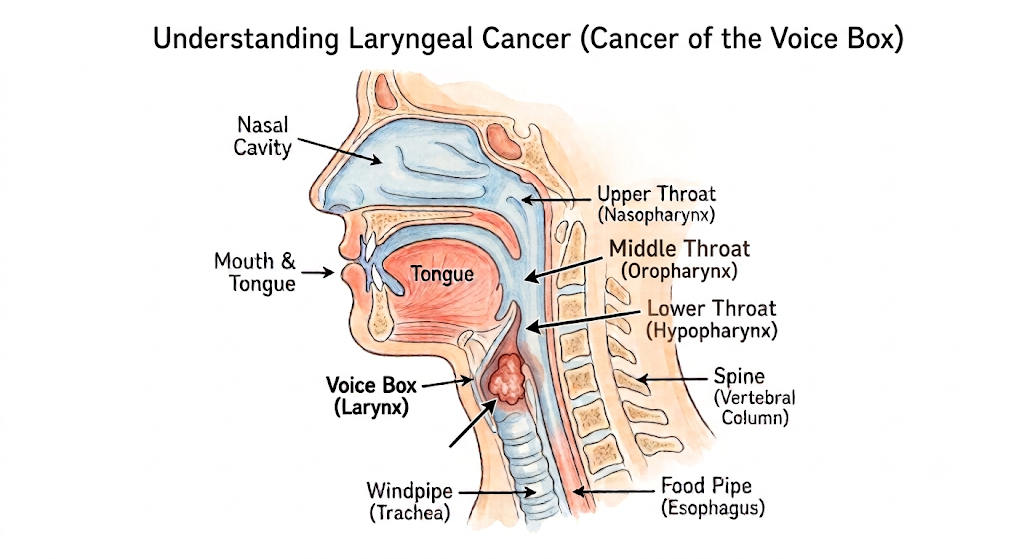
Laryngeal cancer is a condition where abnormal cells grow in the larynx, which is more commonly known as your voice box. The larynx is a vital part of your throat that sits at the top of your windpipe. It plays a key role in helping you breathe, swallow safely, and produce the sounds that make up your voice.
In the UK, approximately 2,400 people are diagnosed with this condition each year. It is the second most common type of head and neck cancer. While it can affect anyone, it is much more common in men over the age of 40. Almost all cases are a type of cancer called squamous cell carcinoma, which starts in the thin, flat cells that line the inside of the voice box. The most common area for these cells to be affected is the glottis, which is the part of the voice box that contains your vocal cords.
Symptoms and Causes
Understanding why this condition develops and what signs to look for is an important step in taking care of your health. While many throat issues are caused by minor infections or irritation, it is important to be aware of changes that do not go away.
Symptoms
The symptoms of laryngeal cancer can vary depending on exactly where in the voice box the cells are growing. Common signs to watch out for include:
- Hoarseness: A change in your voice that lasts for more than two weeks is a key sign that needs to be checked by a doctor.
- Throat discomfort: You may feel a persistent sore throat or a sensation that something is stuck in your throat.
- Difficulty swallowing: This is known as dysphagia, where you feel like food or liquid is catching or struggling to pass down.
- Neck changes: You might notice a new lump in your neck.
- Ear pain: Sometimes, pain from the throat can be felt in the ear.
- Breathing issues: You may feel short of breath or notice a change in your breathing sounds.
- Coughing: A persistent cough or coughing up blood (haemoptysis).
- General health: Unexplained weight loss, feeling very tired, or general weakness.
Causes
While the exact reason why cancer develops in one person and not another is not always clear, we know that certain lifestyle factors play a major role. Smoking is the single biggest avoidable risk factor and is linked to about 79% of all cases. Alcohol consumption is also a significant factor, contributing to about 25% of cases. When someone both smokes and drinks alcohol, the risk increases significantly compared to doing either alone.
Other factors that can increase your risk include being over the age of 55 and being male. Certain jobs that involve long-term exposure to specific substances, such as asbestos, can also play a part. Additionally, the Human Papillomavirus (HPV)—a common virus—is known to be a risk factor for some head and neck cancers.
Diagnosis and Investigations
If you visit your GP with concerns, they will ask about your symptoms and your medical history. If you are aged 45 or over and have a persistent, unexplained hoarse voice or a lump in your neck, you should be referred to a specialist within two weeks for further checks.
Diagnosis
A specialist will perform a thorough physical examination. This often involves looking inside your throat using a fibreoptic laryngoscope, which is a thin, flexible tube with a tiny camera on the end. This allows the doctor to get a clear view of your voice box and surrounding areas to see if there are any visible abnormalities.
Investigations
To confirm a diagnosis, a biopsy is usually required. This is a procedure where a small sample of tissue is taken from the area so it can be examined under a microscope. This is often done while you are under a general anaesthetic (where you are put to sleep) to ensure the doctor can get a good look and take the necessary samples safely.
Imaging tests are also used to see how far the cancer has spread, which is known as staging. These may include:
- CT scans: Detailed X-ray images of your head and neck.
- MRI scans: These use strong magnets to create detailed pictures and are particularly good at showing if the cancer has reached the cartilage (the firm, flexible tissue that supports the voice box).
- Ultrasound: Often used to look at the lymph nodes in the neck.
- PET scans: A special type of scan that can help show if the cancer has spread to other parts of the body.
Management and Treatment
Treatment for laryngeal cancer is often "multimodal," meaning a team of different specialists will work together to provide a combination of treatments tailored to you. The main goal is to cure the cancer while trying to preserve your ability to speak and swallow as much as possible.
Options include:
- Surgery: This might involve removing just the affected part of the voice box (partial laryngectomy) or, in some cases, the entire voice box (total laryngectomy). Sometimes, laser surgery is used to remove small tumours. Lymph nodes in the neck may also be removed if necessary.
- Radiotherapy: This uses high-energy radiation to kill cancer cells. It is often used for early-stage cancers or alongside chemotherapy.
- Chemotherapy: These are medicines that kill cancer cells. They may be given before or after surgery, or at the same time as radiotherapy (chemoradiotherapy).
- Targeted medicines and Immunotherapy: These are newer types of treatments that help your body’s immune system or specific pathways to fight the cancer cells.
If you undergo radiotherapy, you might experience side effects like a dry mouth. Doctors may suggest special mouth rinses or medications to help manage this. If you have advanced cancer, the focus may shift to palliative care, which is all about managing symptoms and ensuring you have the best possible quality of life.
Prevention
While not all cases can be prevented, you can significantly lower your risk by making healthy lifestyle choices. Avoiding smoking is the most effective way to protect your voice box. Reducing or stopping alcohol consumption also makes a big difference. Eating a healthy, balanced diet that is rich in fruits and vegetables is recommended, as this can help prevent many types of head and neck cancers. Additionally, staying up to date with vaccinations, such as those for HPV, may help reduce your risk.
Outlook / Prognosis
Recovering from laryngeal cancer is a journey that can take several months. It is normal to feel a range of emotions during this time. You may face challenges regarding your voice, your appearance, or how you eat and drink. It is important to know that you are not alone in this process.
Many people find that their lives are permanently changed, especially if they have had surgery to remove the voice box. This can lead to feelings of isolation or a loss of identity, but there are many resources available to help you adjust to these changes. Recovery is not just physical; it is also about finding new ways to communicate and connecting with others who have been through similar experiences. With the right support, many people go on to live full and meaningful lives after their treatment, focusing on their long-term well-being and adapting to their new normal.
Need Expert Advice?
Book a consultation with Mr Ahmad Hariri to discuss your symptoms and treatment options.
Book a Consultation