
Epidermoid & Sebaceous Cysts

Disclaimer: Disclaimer: This leaflet provides general information and is intended for educational purposes only. It should not be used as a substitute for professional medical advice, diagnosis, or treatment. Always seek the advice of a qualified healthcare professional for any health concerns or before making any decisions related to your health or treatment.
This leaflet may contain links to external websites or resources (e.g. YouTube) for demonstration purposes; however, these links are provided for information only. Clinicol.co.uk is not affiliated with, does not endorse, and is not responsible for the content, accuracy, or copyright compliance of these external sources. Use of these external links is at your own discretion and risk.
Overview
An epidermoid cyst is a very common, harmless lump that sits just underneath the surface of your skin. You might have heard them called "sebaceous cysts" in the past, but this is actually an outdated term. They do not involve your sebaceous (sweat and grease) glands at all.
By definition, a cyst is a closed sac. In the case of an epidermoid cyst, the lining of the sac is made of the exact same cells that make up the very outer layer of your skin (the epidermis). Inside the sac is a thick, white, cheesy-looking substance. This is simply "keratin"—a normal, soggy version of the protein that makes up your hair, nails, and outer skin.
Epidermoid cysts are completely benign (non-cancerous), and you cannot catch them from or pass them on to anyone else. While we also often see "pilar cysts" (which are nearly identical but form from hair roots, usually on the scalp), the focus of this leaflet is primarily on epidermoid cysts.
Symptoms and Causes
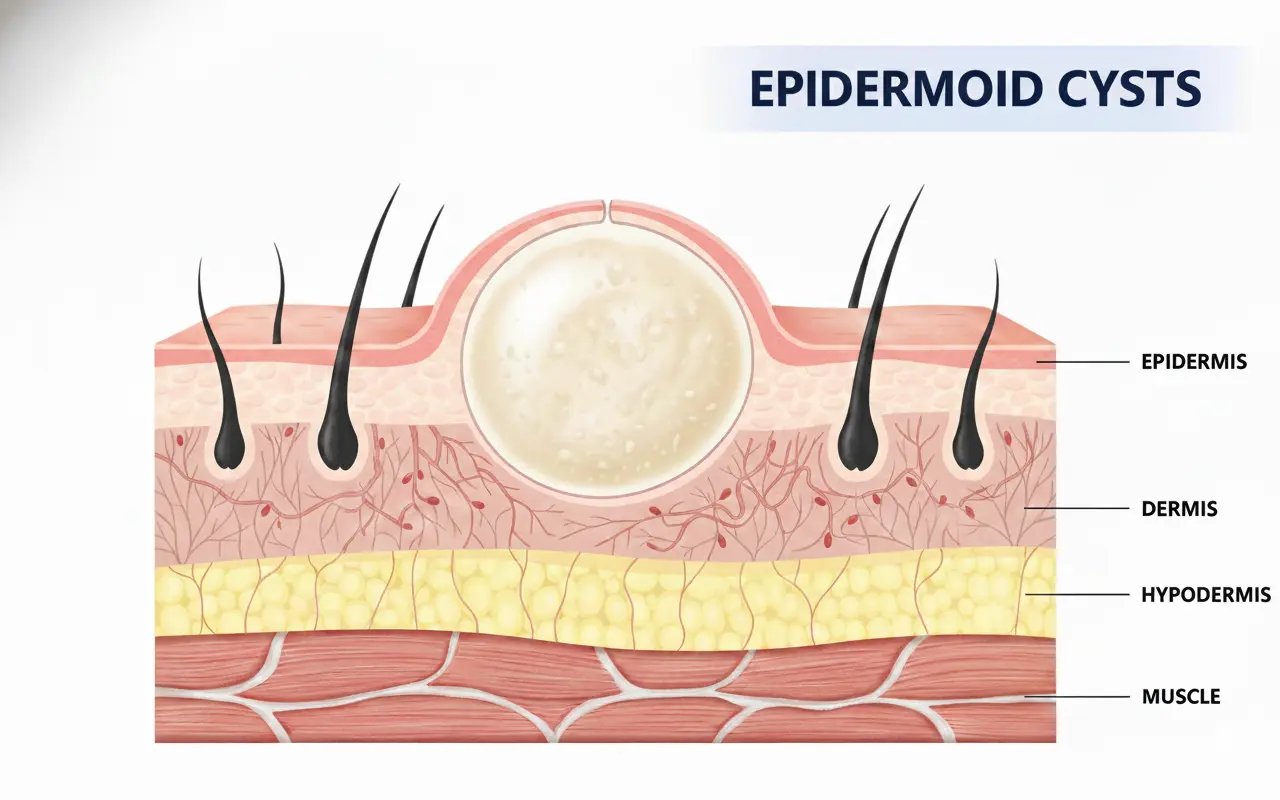
Symptoms
Most of the time, an epidermoid cyst is entirely painless. You will usually notice:
- A firm, round, dome-shaped bump under the skin.
- A flesh-coloured, yellowish, or whitish lump.
- A tiny dark plug or pore in the centre of the lump (known medically as a punctum).
- Sometimes, if squeezed, the cyst might ooze a thick, foul-smelling, cheesy material.
- They grow very slowly over time, ranging from the size of a small pea to a few centimetres across.
If the cyst becomes infected, the symptoms will change. The lump will become red, hot, swollen, and quite tender or sore to the touch.
Causes
Normally, our skin constantly sheds dead cells. However, sometimes these surface cells get pushed deeper into the skin—often due to a blocked pore, inflamed hair follicle (like in acne), or minor skin damage. Instead of shedding, these cells multiply and form a little sac, which gradually fills with keratin.
They are not caused by poor hygiene. They are most common in young to middle-aged adults and are about twice as likely to affect men as women. While simple epidermoid cysts are not usually hereditary, they can sometimes run in families.
Diagnosis and Investigations
Because epidermoid cysts look and feel quite typical, your GP or an ENT surgeon can usually diagnose them simply by examining the lump. We rarely need to do any special scans or blood tests.
During the examination, your doctor will feel the lump to check its size, how mobile it is, and whether it is infected. We are also checking to make sure it isn't something else, such as a lipoma (a soft, harmless collection of fat) or a standard skin abscess.
In the highly unlikely event that the lump looks unusual, it can be removed in a minor operation and sent to a laboratory. There, it is looked at under a microscope (a process called histology) just to confirm the diagnosis and give you complete peace of mind.
Management and Treatment
Many epidermoid cysts are small, unnoticeable, and cause no trouble at all. If this is the case, the best treatment is often doing nothing. Sometimes, they even disappear on their own. However, if treatment is needed, here is how we manage them:
1. Treating an Infection (Medication)
If your cyst becomes red, hot, and painful, it is likely infected. Your doctor will normally prescribe antibiotics.
- Flucloxacillin (Prescription Only): This is the most common British antibiotic prescribed for skin infections.
- When to take it: It is usually taken four times a day. You must take it on an empty stomach (one hour before food or two hours after eating), as food stops your body from absorbing the medicine properly. Always finish the full course.
- Paracetamol and Ibuprofen (Available Over-The-Counter - OTC): To manage the pain and swelling of an infected cyst, you can buy these easily at any pharmacy or supermarket.
- When to take them: Paracetamol can be taken every 4 to 6 hours (maximum 8 tablets in 24 hours). Ibuprofen reduces inflammation and can be taken up to three times a day, but it must be taken with or just after food to protect your stomach.
2. Surgical Removal
If a cyst is large, catches on clothing, is unsightly, or gets infected repeatedly, we can remove it.
- Complete Excision: This is a minor operation done under local anaesthetic (an injection to completely numb the area, so you feel no pain). The surgeon makes a small cut and removes the entire sac and its contents. Removing the whole sac is vital, as it stops the cyst from growing back. This will leave a small, permanent scar.
- Lancing (Incision and Drainage): If the cyst is actively infected and full of pus, it might be too inflamed for a full removal. Instead, we may make a tiny cut to drain the fluid, pack it with a sterile dressing, and let it heal. However, because the sac wall stays behind, the cyst is quite likely to return later.
Prevention
Because epidermoid cysts mostly happen randomly or as a result of everyday skin irritation, there is no guaranteed way to prevent them.
However, the most important advice I can give you is do not squeeze or pop them. Squeezing forces the cheesy keratin deep into the surrounding skin, which causes severe inflammation, increases the risk of a painful infection, and creates internal scarring that makes the cyst much harder to remove surgically later on. Keeping your skin clean and managing conditions like acne can also help reduce your chances of developing blocked pores.
Outlook / Prognosis
The outlook is excellent. Epidermoid cysts are completely harmless and are very rarely a cause for concern. If you choose to leave a quiet cyst alone, it will simply sit there, perhaps growing very slowly.
If you decide to have it removed, the minor surgery is highly successful. As long as the entire lining of the sac is removed during the procedure, that specific cyst is entirely cured and will not come back. It is worth noting, however, that if you are prone to skin cysts, you may develop new, separate ones elsewhere on your body over time.
If you find any new lump on your skin, it is always best to have it checked by your GP to ensure the diagnosis is correct.
Need Expert Advice?
Book a consultation with Mr Ahmad Hariri to discuss your symptoms and treatment options.
Book a Consultation