
Parotid Lumps

Disclaimer: Disclaimer: This leaflet provides general information and is intended for educational purposes only. It should not be used as a substitute for professional medical advice, diagnosis, or treatment. Always seek the advice of a qualified healthcare professional for any health concerns or before making any decisions related to your health or treatment.
This leaflet may contain links to external websites or resources (e.g. YouTube) for demonstration purposes; however, these links are provided for information only. Clinicol.co.uk is not affiliated with, does not endorse, and is not responsible for the content, accuracy, or copyright compliance of these external sources. Use of these external links is at your own discretion and risk.
Overview
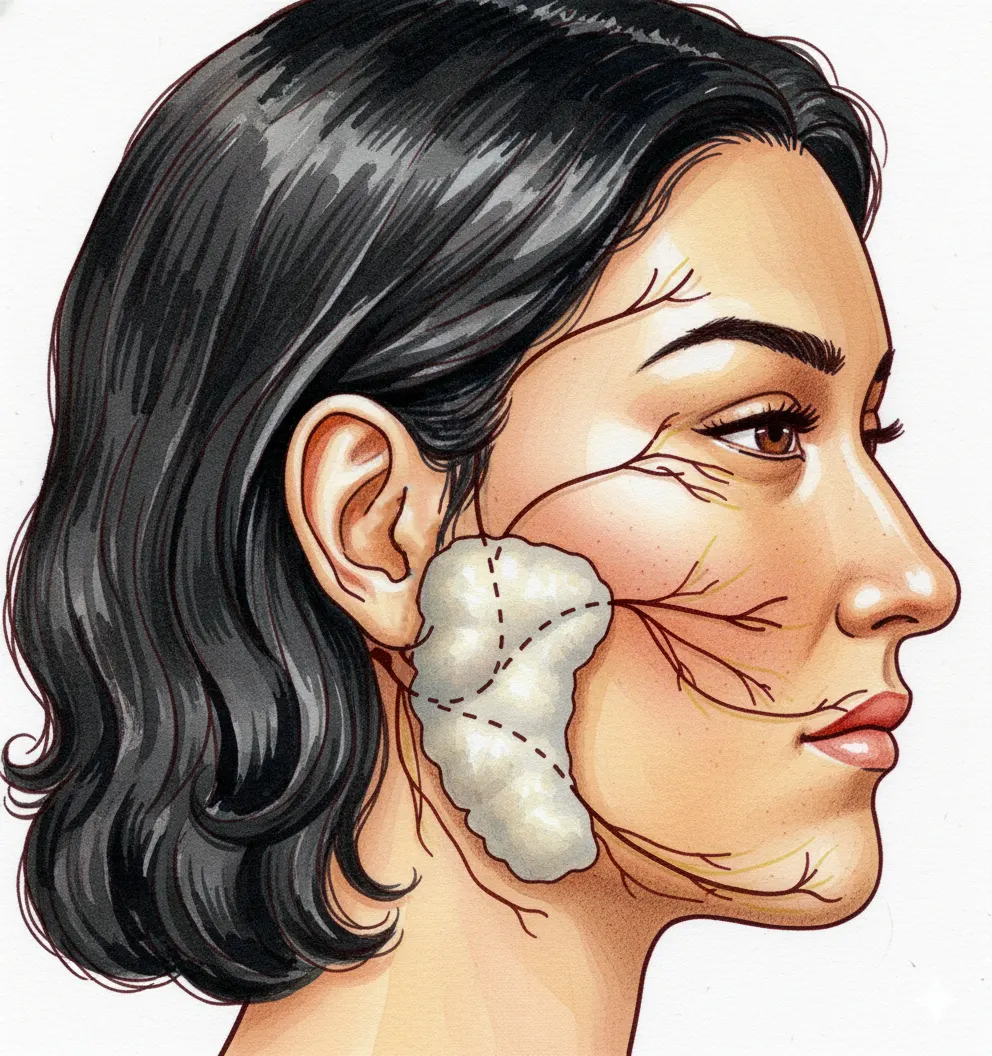
The parotid glands are the largest of the salivary glands, which are responsible for producing the saliva that helps you chew, swallow, and digest your food. You have two parotid glands, one located on each side of your face, just in front of your ear and extending down toward the jawline. A parotid lump is an area where cells have grown abnormally, creating a mass or swelling in this specific region.
It is very common for people to feel anxious when they discover a lump in their neck or face, but it is important to know that the vast majority of these growths are benign, meaning they are non-cancerous. In fact, about 80% of all parotid tumours are non-cancerous. While these growths can occur at any age, benign lumps are most commonly found in people over the age of 40. Malignant (cancerous) tumours are much rarer, typically appearing in people over the age of 60. Because these lumps can grow over time and potentially cause issues with nearby structures, doctors usually recommend a thorough investigation and often surgical removal to ensure your long-term health.
Symptoms and Causes
Most parotid lumps develop slowly and quietly. Because the gland is tucked in front of the ear, you might not notice a small lump until it reaches a certain size or you happen to feel it while washing your face or shaving.
Symptoms
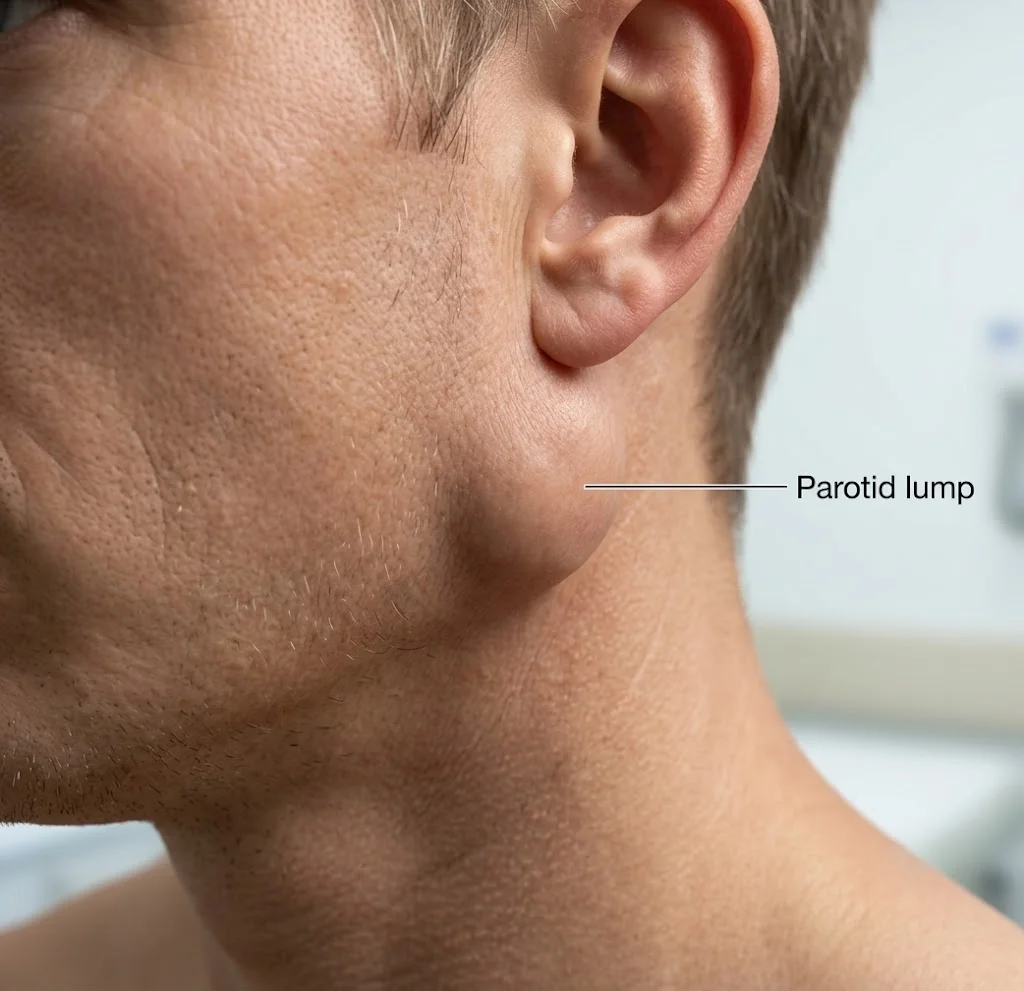
The most common sign of a parotid lump is a painless swelling or a firm mass in the area just in front of or below the ear. In most cases, the lump is the only symptom. However, you should see a specialist if you notice any of the following:
- A lump that seems to be growing quickly.
- Pain in the area of the gland.
- Weakness in the muscles of your face, such as difficulty smiling or closing your eye on one side.
- Changes to the skin over the lump, such as redness or dimpling.
- Swollen lymph nodes in the neck.
If you experience any of these more concerning symptoms, it is important to seek medical advice promptly so that your doctor can assess the situation.
Causes
A parotid lump is essentially an overgrowth of cells within the gland. While we do not always know exactly why these cells start to multiply, they can form different types of growths. The most common benign type is called a pleomorphic adenoma. Another common type is a Warthin’s tumour. While benign tumours do not spread to other parts of the body, they can continue to grow, which is why doctors often advise having them removed. In rare cases, some benign tumours can change over time and become cancerous, which is another reason why early treatment is usually suggested. Malignant tumours are much less common and include types like mucoepidermoid carcinoma or adenoid cystic carcinoma. Other causes for a lump in this area can include inflamed lymph nodes, which are part of your immune system, or, very rarely, a spread of skin cancer from the face or scalp.
Diagnosis and Investigations
Because there are many different types of lumps that can occur in the parotid gland, your doctor will need to perform a series of tests to understand exactly what is happening. This process helps the medical team create the best possible plan for your care.
Diagnosis
Your journey begins with a consultation where a specialist will take a detailed history of your health. They will ask how long the lump has been there, if it has changed in size, and if you have any pain or other symptoms. During the physical examination, the doctor will carefully feel the lump to check its size, texture, and whether it feels fixed in place or moves slightly under the skin. They will also examine your face and neck to check for any other signs of swelling or nerve issues.
Investigations
To get a clearer picture, your doctor will likely order several tests:
- Ultrasound scan: This uses sound waves to create an image of the lump, helping the doctor see if it is solid or fluid-filled.
- Fine Needle Aspiration Cytology (FNAC): This is a very common and helpful test. A doctor uses a very thin needle to take a small sample of cells from the lump. These cells are then looked at under a microscope to help identify the type of growth.
- Core Needle Biopsy: If the FNAC does not provide enough information, your doctor might perform a core biopsy, which takes a slightly larger tissue sample to get a more detailed diagnosis.
- MRI or CT scans: These are detailed imaging tests that provide a 3D map of the area. They are particularly useful if the lump is deep, if it feels fixed, or if the doctor needs to see exactly how the lump relates to the facial nerve and other nearby structures.
Management and Treatment
The primary treatment for most parotid lumps is surgery, known as a parotidectomy. This is a procedure to remove the tumour and a small margin of healthy tissue around it. For benign, well-defined lumps, the surgeon will aim to remove the tumour while carefully preserving the facial nerve, which runs through the gland and controls your facial expressions. If the lump is suspected to be cancerous, the surgery may be more extensive to ensure all the affected tissue is removed, and in some cases, the surgeon may also remove nearby lymph nodes in the neck.
If the tumour is found to be malignant, your care will be managed by a multidisciplinary team—a group of different specialists who work together to plan your treatment. In some cases, especially if the tumour is large or high-grade, you may be offered radiotherapy after surgery. This uses targeted energy beams to destroy any remaining cancer cells and improve your long-term outcome. For some specific types of benign tumours, such as Warthin’s tumour, your doctor might occasionally suggest simply monitoring the lump if it is small and not causing any issues, though this is a decision made on a case-by-case basis.
Prevention
Currently, there are no specific lifestyle changes or preventative measures that can stop a parotid lump from forming. Because these growths are often related to the natural, random way cells divide within the gland, they are not typically caused by diet, environment, or lifestyle habits. The best approach to "prevention" is simply being aware of your own body. If you notice a new or persistent lump in front of your ear, do not ignore it. Getting it checked by a GP or an ENT specialist early is the most effective way to ensure that if a problem exists, it is caught and managed at the earliest possible stage.
Outlook / Prognosis
The outlook for most people with a parotid lump is very positive. Because the vast majority of these lumps are benign, most patients recover fully after treatment. If you have a benign tumour removed, the goal is to cure the condition completely. However, it is important to follow up with your medical team as advised, as some benign tumours can recur if not removed entirely.
Living with a parotid lump that is left untreated can lead to the mass continuing to grow. Over time, a large lump can become more difficult to remove and may eventually press on the facial nerve, which could lead to weakness or numbness in your face. By choosing to have the lump investigated and treated, you are taking the best step to protect your facial function and your long-term health. After your recovery, most people return to their normal daily activities within a few weeks. While you may have some numbness around the earlobe or cheek area following surgery, this often becomes less noticeable over time, and your medical team will support you throughout your recovery to ensure you have the best possible quality of life.
Need Expert Advice?
Book a consultation with Mr Ahmad Hariri to discuss your symptoms and treatment options.
Book a Consultation