
Primary Hyperparathyroidism

Disclaimer: Disclaimer: This leaflet provides general information and is intended for educational purposes only. It should not be used as a substitute for professional medical advice, diagnosis, or treatment. Always seek the advice of a qualified healthcare professional for any health concerns or before making any decisions related to your health or treatment.
This leaflet may contain links to external websites or resources (e.g. YouTube) for demonstration purposes; however, these links are provided for information only. Clinicol.co.uk is not affiliated with, does not endorse, and is not responsible for the content, accuracy, or copyright compliance of these external sources. Use of these external links is at your own discretion and risk.
Overview
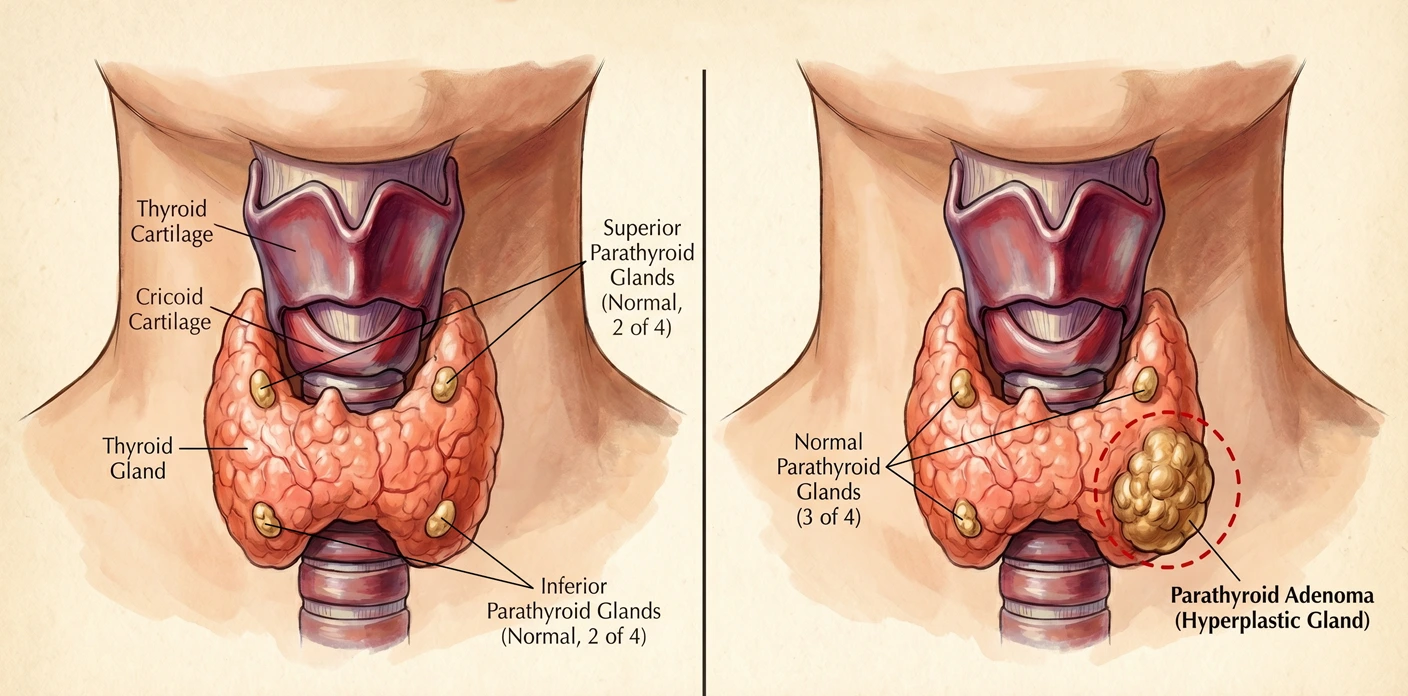
Primary Hyperparathyroidism (PHPT) is a condition where one or more of your parathyroid glands become overactive and produce too much parathyroid hormone (PTH). You have four tiny parathyroid glands, usually located in your neck behind your thyroid gland. These glands are crucial because they act like a thermostat, carefully controlling the amount of calcium in your blood. Calcium is vital for strong bones, healthy nerves, and proper muscle function, including your heart.
When your parathyroid glands make too much PTH, it causes your blood calcium levels to rise higher than they should be. This high blood calcium is called hypercalcaemia. PHPT is a common condition, and it's often discovered by chance during routine blood tests for other reasons, even before you notice any specific symptoms. However, if left untreated, high calcium levels can lead to a range of health problems affecting your bones, kidneys, and general well-being.
Symptoms and Causes
Primary Hyperparathyroidism occurs when your parathyroid glands don't regulate calcium properly, leading to an excess of parathyroid hormone and high calcium in your blood. This imbalance can affect many parts of your body, causing a variety of symptoms.
Symptoms
The symptoms of PHPT can be quite varied and often feel vague, which is why it can sometimes take a while to diagnose. Some people might not notice any symptoms at all, while others experience a range of issues. Common symptoms include:
- Tiredness and Fatigue: Feeling unusually tired, even after a good night's sleep, is a very common complaint.
- Low Mood and Depression: Many people report feeling down, irritable, or experiencing symptoms of depression and anxiety.
- Joint and Muscle Pain: Aches and pains in your joints and muscles, sometimes described as general weakness.
- Thirst and Frequent Urination: Feeling unusually thirsty and needing to pass urine more often than usual, especially at night.
- Constipation: Difficulty passing stools regularly.
- Mild Nausea: Feeling slightly sick or queasy.
- Forgetfulness and Cognitive Changes: Some people notice problems with memory, concentration, or generally feeling a bit "foggy" mentally.
More serious problems can develop over time due to persistently high calcium levels. These include:
- Osteoporosis and Fragility Fractures: High PTH can cause calcium to be drawn from your bones, making them weaker and more brittle. This can lead to osteoporosis (a condition where bones become thin and weak) and an increased risk of fragility fractures (broken bones from minor falls or impacts).
- Kidney Stones: Excess calcium in your blood can lead to the formation of kidney stones (hard deposits that form in your kidneys and can cause severe pain and blockages).
- Impaired Kidney Function: Over time, high calcium levels can affect how well your kidneys work.
- Gastric Ulcers and Pancreatitis: Although rare, PHPT can sometimes lead to problems like stomach ulcers or inflammation of the pancreas (pancreatitis).
- Falls: Muscle weakness and general fatigue can increase the risk of falls.
- Cardiovascular Issues: There can be a potential link to heart and blood vessel problems.
Causes
In most cases, Primary Hyperparathyroidism is caused by a problem with one or more of your parathyroid glands themselves. The most common reasons are:
- Single Benign Tumour (Adenoma): This is the cause in about 80 to 85 out of every 100 people with PHPT. An adenoma is a non-cancerous (benign) growth on just one of your parathyroid glands. This growth causes that single gland to become overactive and produce too much PTH.
- Enlargement of Multiple Glands (Hyperplasia) or Multiple Adenomas: In about 10 to 15 out of every 100 cases, more than one parathyroid gland becomes enlarged and overactive. This is known as hyperplasia, or sometimes multiple benign tumours (adenomas) can develop.
- Parathyroid Carcinoma (Cancer): This is extremely rare, accounting for less than 1 out of every 100 cases. It involves a cancerous growth on a parathyroid gland.
While most cases happen without a clear reason, some factors can increase your risk:
- Genetic Conditions: Certain inherited conditions, such as Multiple Endocrine Neoplasia type 1 (MEN1), Multiple Endocrine Neoplasia type 2A (MEN2A), and Hyperparathyroidism-Jaw Tumour syndrome (HPT-JT), can make you more likely to develop PHPT.
- Previous Head or Neck Radiotherapy: If you have had radiation treatment to your head or neck area in the past, this can also be a risk factor.
Diagnosis and Investigations
Diagnosing Primary Hyperparathyroidism involves a careful review of your symptoms and a series of specific tests to confirm the condition and understand its impact on your body.
Diagnosis
Your doctor will start by asking you about your medical history and any symptoms you've been experiencing. Because the symptoms can be vague, the diagnosis often begins with blood tests. The key to diagnosing PHPT is finding persistently high levels of calcium in your blood, along with high or inappropriately normal levels of parathyroid hormone (PTH).
Specifically, your doctor will look for:
- Persistently High Blood Calcium: This means your albumin-adjusted serum calcium level is 2.6 mmol/litre or higher (or 2.5 mmol/litre or higher if PHPT is strongly suspected) on at least two separate occasions. The "albumin-adjusted" part is important because albumin is a protein in your blood that can affect calcium measurements, so adjusting for it gives a more accurate picture.
- Concurrent PTH Measurement: At the same time as your high calcium, your parathyroid hormone (PTH) level will be measured. In PHPT, the PTH level will be high or, sometimes, at the upper end of the normal range, which is still considered "inappropriately normal" because it should be low when calcium is high.
It's also important to rule out other conditions that can cause high calcium. One condition your doctor will consider is Familial Hypocalciuric Hypercalcaemia (FHH). This is a rare, usually harmless genetic condition that also causes high calcium, but it's different from PHPT and doesn't usually require surgery. Differentiating between PHPT and FHH often involves specific urine calcium excretion tests.
Investigations
Once PHPT is suspected or confirmed, your doctor will arrange further investigations to assess how the condition is affecting your body and to help plan your treatment. These may include:
- Blood Tests:
- eGFR or Serum Creatinine: These tests measure your kidney function to see if the high calcium is affecting your kidneys.
- Vitamin D Levels: Your vitamin D levels will be checked, as vitamin D plays a role in calcium regulation. If your levels are low, you may be advised to take supplements.
- Urine Tests:
- 24-hour Urine Calcium: This test involves collecting all your urine over a 24-hour period to measure how much calcium your body is passing. It's particularly useful for helping to tell the difference between PHPT and FHH.
- Bone Health Assessment:
- DXA Scan (Dual-energy X-ray Absorptiometry): This is a special type of X-ray that measures bone mineral density. It's used to check for osteoporosis or reduced bone density, typically in your lumbar spine (lower back), distal radius (wrist), and hip.
- Vertebral X-ray: Sometimes, an X-ray of your spine may be taken to look for any fractures in the bones of your back.
- Kidney Health Assessment:
- Ultrasound of the Renal Tract: This scan uses sound waves to create images of your kidneys and bladder. It helps to check for kidney stones or any other changes in your kidneys.
- Preoperative Imaging (if surgery is being considered):
These scans are not used to diagnose PHPT, but rather to help your surgeon locate the overactive parathyroid gland(s) before surgery. This helps them plan the best surgical approach. - Ultrasound of the Neck: This uses sound waves to create images of your neck and can often identify an enlarged parathyroid gland.
- Sestamibi Scan: This is a nuclear medicine scan where a small amount of a radioactive tracer is injected into your bloodstream. Overactive parathyroid glands tend to absorb more of this tracer, making them visible on the scan.
- 4D CT Scan: This is a more advanced CT (computed tomography) scan that provides detailed 3D images over time, which can be very helpful in pinpointing the exact location of an abnormal gland.
Management and Treatment
The management of Primary Hyperparathyroidism depends on your symptoms, the severity of your high calcium levels, and whether the condition has caused any damage to your bones or kidneys. There are generally two main approaches: careful monitoring or active treatment, most commonly surgery.
Careful Monitoring (Watchful Waiting):
If you have no symptoms, only slightly elevated calcium levels, and your bone and kidney health appear normal, your doctor may recommend careful monitoring. This involves regular check-ups and blood tests to keep an eye on your calcium levels, kidney function, and your risk of heart problems or fractures. This approach is only suitable for a small number of patients, and your doctor will discuss if it's right for you.
Surgical Intervention (Parathyroidectomy):
Surgery to remove the overactive parathyroid gland(s), called a parathyroidectomy, is the only treatment that can cure Primary Hyperparathyroidism. It is often recommended for most patients, even those who don't have obvious symptoms, because it can prevent long-term complications and significantly improve your health. Surgery is usually recommended if you have:
- Symptoms: If you are experiencing any of the symptoms of PHPT, such as fatigue, low mood, or joint pain.
- End-Organ Damage: This includes problems like kidney stones, reduced bone mineral density (osteoporosis), impaired kidney function, or fragility fractures.
- Significantly High Calcium Levels: If your blood calcium levels are consistently very high (for example, 2.85 mmol/litre or higher).
- Age: Surgery is often recommended for asymptomatic patients over the age of 50 to reduce the risk of future complications.
Before surgery, your surgeon will use the preoperative imaging scans (like ultrasound, Sestamibi, or 4D CT) to help locate the abnormal gland(s). This helps them plan the best way to perform the operation. During the surgery, the affected gland(s) are carefully removed. After the operation, your calcium levels will be closely monitored to ensure they return to normal.
Medical Management:
For some patients, surgery may not be suitable due to other health conditions, or they may choose not to have surgery. In these cases, medication can be considered to help manage the symptoms and lower calcium levels, although it doesn't cure the underlying problem.
- Cinacalcet: This medication works by making your parathyroid glands less sensitive to calcium, which helps to reduce the amount of PTH they produce. This, in turn, lowers your blood calcium levels and can help to relieve symptoms. However, cinacalcet does not improve bone density or reduce the risk of kidney stones.
- Anti-Osteoporosis Drugs: If you have reduced bone density or osteoporosis, your doctor may prescribe medications like alendronate to help strengthen your bones.
- Vitamin D Supplementation: Maintaining healthy vitamin D levels (above 30 ng/mL) is important. If your vitamin D levels are low, your doctor will advise you on appropriate supplements.
Prevention
Primary Hyperparathyroidism is typically caused by a benign growth (adenoma) on a parathyroid gland or the enlargement of multiple glands. Because of this, it's not usually a condition that can be prevented through lifestyle changes in the same way some other health issues can be.
However, there are important steps related to early detection and managing associated risks:
- Regular Health Check-ups: Since PHPT is often discovered incidentally during routine blood tests, having regular check-ups with your GP can lead to early detection, even before you experience significant symptoms.
- Awareness of Risk Factors: If you have a family history of genetic conditions linked to PHPT (such as MEN1, MEN2A, or HPT-JT) or if you've had radiotherapy to your head or neck in the past, it's important to discuss these with your doctor. They may recommend specific monitoring.
- Maintaining Healthy Vitamin D Levels: While not preventing PHPT itself, ensuring you have adequate vitamin D levels is crucial for overall bone health and calcium regulation. Your doctor may advise supplements if your levels are low.
- Staying Hydrated: Drinking plenty of water can help reduce the risk of kidney stone formation, which is a common complication of PHPT. This is a general health recommendation that becomes even more important if you have high calcium levels.
The most effective "prevention" in PHPT often comes from early diagnosis and appropriate treatment to prevent the long-term complications of high calcium levels on your bones, kidneys, and general health.
Outlook / Prognosis
The long-term outlook for people with Primary Hyperparathyroidism is generally very good, especially with appropriate treatment. However, if the condition is left untreated, the persistently high calcium levels can lead to significant and serious health problems over time.
Without Treatment:
If PHPT is not treated, the ongoing high calcium can cause a range of complications, including:
- Bone Weakening: Continued loss of calcium from your bones can lead to severe osteoporosis, making your bones fragile and significantly increasing your risk of painful fractures from minor incidents.
- Kidney Damage: The risk of developing kidney stones increases, which can cause severe pain and potentially lead to kidney damage or impaired kidney function over time.
- Neuropsychiatric Symptoms: Persistent fatigue, depression, anxiety, and problems with memory or concentration can significantly affect your quality of life.
- Other Complications: There's an increased risk of falls, constipation, and in rare cases, more serious issues like pancreatitis or gastric ulcers. There can also be potential long-term effects on your heart and blood vessels.
With Successful Treatment (especially Surgery):
For most people, surgery to remove the overactive parathyroid gland(s) offers a complete cure for Primary Hyperparathyroidism. Following successful surgery:
- Improved Bone Health: Your bone density often improves, reducing your risk of fractures and reversing some of the effects of osteoporosis.
- Reduced Kidney Stone Risk: The likelihood of developing new kidney stones significantly decreases, and existing kidney function can stabilise.
- Enhanced Well-being: Many people report a noticeable improvement in their energy levels, mood, memory, and overall sense of well-being. Symptoms like fatigue, depression, and joint pain often get better.
- Long-Term Cure: The vast majority of patients are cured after surgery, meaning their calcium and PTH levels return to normal. While a small number of patients might need further intervention in the future, the initial success rate is very high.
With Medical Management:
If you are managed with medication like cinacalcet, your blood calcium levels can be lowered, and many of your symptoms may improve. However, it's important to remember that medical treatment manages the symptoms but does not cure the underlying problem. It also doesn't typically improve bone density or reduce the risk of kidney stones in the same way surgery does.
Regardless of the treatment approach, long-term monitoring of your calcium levels, kidney function, and your risk of cardiovascular problems and fractures is usually advised. This helps ensure that your condition remains well-controlled and any potential issues are identified early.
Need Expert Advice?
Book a consultation with Mr Ahmad Hariri to discuss your symptoms and treatment options.
Book a Consultation