
Throat Cancer

Disclaimer: Disclaimer: This leaflet provides general information and is intended for educational purposes only. It should not be used as a substitute for professional medical advice, diagnosis, or treatment. Always seek the advice of a qualified healthcare professional for any health concerns or before making any decisions related to your health or treatment.
This leaflet may contain links to external websites or resources (e.g. YouTube) for demonstration purposes; however, these links are provided for information only. Clinicol.co.uk is not affiliated with, does not endorse, and is not responsible for the content, accuracy, or copyright compliance of these external sources. Use of these external links is at your own discretion and risk.
Overview
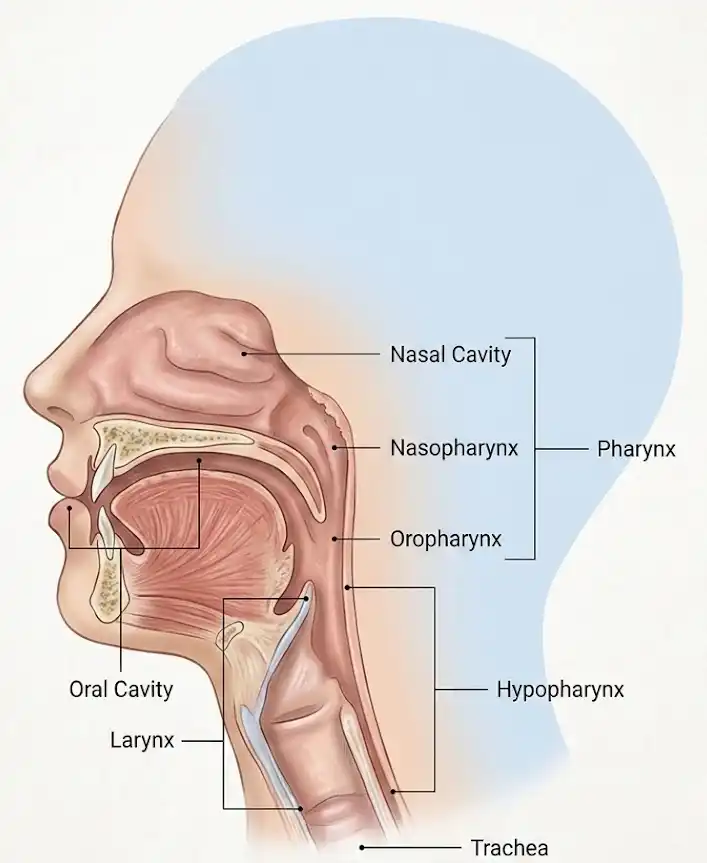
Throat cancer is a general term that describes cancers affecting parts of your throat, specifically the pharynx and the larynx. The pharynx is the tube that runs from behind your nose down to your gullet, and the larynx is your voice box. In the UK, around 2,000 people are diagnosed with throat cancer each year. It tends to be more common in men, particularly those over the age of 70.
Within the broader category of head and neck cancers, which also include those of the mouth and other areas, there are about 12,500 new cases in the UK annually. Most of these cancers are a type called squamous cell carcinoma. Laryngeal cancer, which affects the voice box, is a specific type of throat cancer. While it can be a worrying diagnosis, understanding the condition and its treatments is the first step towards managing it effectively.
Symptoms and Causes
Understanding the signs and what can increase your risk of throat cancer is very important for early detection and better outcomes. This section will explain the common symptoms to look out for and the main factors that can contribute to developing this condition.
Symptoms
The symptoms of throat cancer can vary depending on exactly where the cancer is located. However, there are several common signs that should prompt you to see your doctor, especially if they last for more than a few weeks. Early detection is key, so it's important to be aware of these:
- Persistent Hoarse Voice: This is a very common symptom, particularly if the cancer is in your voice box (larynx). If your voice remains hoarse for more than 2 to 4 weeks, you should get it checked.
- Sensation of a Lump in the Throat: You might feel as though there's something stuck in your throat, even when you're not eating or drinking.
- Pain or Difficulty Swallowing: This can range from discomfort to actual pain when you swallow food or liquids. Sometimes this pain might feel like it's on one side of your throat and lasts for over three weeks. This is known as odynophagia.
- Difficulty Breathing: As the cancer grows, it can sometimes affect your airways, making it harder to breathe.
- Unexplained Weight Loss: Losing weight without trying, especially if you haven't changed your diet or exercise routine, can be a symptom of various health issues, including cancer.
- Swelling in the Neck Glands: If the cancer spreads to the lymph nodes (small glands that are part of your immune system) in your neck, you might notice a lump or swelling there. Sometimes, younger patients with HPV-related throat cancers might first notice a neck lump.
- Persistent Unilateral Throat Pain: Pain in one side of your throat that doesn't go away after three weeks is a significant warning sign.
It's important to remember that these symptoms can also be caused by less serious conditions. However, if you experience any of these persistently, especially for more than a few weeks, it's crucial to speak to your GP.
Causes
Throat cancer develops when cells in the throat grow abnormally and uncontrollably. While the exact reason this happens isn't always clear, certain factors significantly increase your risk:
- Smoking: Smoking tobacco products is a major risk factor for many cancers, including throat cancer. The harmful chemicals in tobacco can damage the cells lining your throat, leading to cancerous changes.
- Regular Heavy Alcohol Consumption: Drinking large amounts of alcohol regularly can also increase your risk. Alcohol can irritate and damage the cells in your throat, making them more vulnerable to cancer. The risk is even higher for people who both smoke and drink heavily.
- Human Papillomavirus (HPV) Infection: HPV is a common virus that can be passed on through close contact. Certain types of HPV are known to cause throat cancers, particularly in the oropharynx (the middle part of the throat behind the mouth). HPV-related throat cancers can sometimes affect younger patients. There is a campaign for gender-neutral HPV vaccination to help reduce the incidence of these cancers.
Diagnosis and Investigations
If you have symptoms that suggest throat cancer, your doctor will want to investigate further to understand what's causing them. The diagnostic process involves a careful examination and a series of tests to confirm a diagnosis and determine the extent of any cancer.
Diagnosis
The journey to diagnosis usually begins with a visit to your GP or a specialist. They will start by taking a detailed medical history, asking about your symptoms, how long you've had them, and any risk factors you might have. They will also perform a clinical examination, which involves looking at your mouth and throat and feeling your neck for any lumps or swelling.
If your GP or specialist suspects throat cancer, particularly laryngeal cancer (cancer of the voice box), they will refer you for further tests. Receiving a diagnosis can be an overwhelming time, and you will be supported by a multidisciplinary team (MDT) of specialists. This team often includes a clinical nurse specialist (CNS) who will be your main point of contact for questions and to help coordinate your care throughout your treatment journey.
Investigations
To get a clear picture of what's happening, several investigations may be carried out:
- Endoscopy: This procedure involves using a thin, flexible tube with a camera on the end to visually examine the inside of your nose, throat, and mouth.
- Laryngoscopy: This is a more specific type of endoscopy focused on inspecting your voice box (larynx). During this procedure, the doctor might also take a small tissue sample, called a biopsy, from any suspicious areas. This sample is then sent to a laboratory to be examined under a microscope to check for cancer cells.
- Needle Biopsy: If you have a lump in your neck, a fine needle may be used to take a small sample of cells from the lump. This is also sent for laboratory analysis.
- Imaging Scans: Various scans help doctors see inside your body and check if the cancer has spread. These can include:
- CT (Computed Tomography) Scan: Uses X-rays to create detailed cross-sectional images of your head, neck, chest, and upper abdomen.
- MRI (Magnetic Resonance Imaging) Scan: Uses strong magnetic fields and radio waves to produce detailed images of soft tissues in your head and neck.
- Ultrasound Scan: Uses sound waves to create images of structures in your neck, often used to examine lymph nodes.
- PET (Positron Emission Tomography) Scan: Uses a special dye containing radioactive tracers to highlight areas of increased cell activity, which can indicate cancer.
- Vocal Cord Checks: Your doctor will also assess the movement of your vocal cords, as this can be affected by laryngeal cancer.
These tests help the multidisciplinary team understand the exact nature and stage of the cancer, which is crucial for planning the most effective treatment.
Management and Treatment
The treatment for throat cancer is carefully planned by a team of specialists, known as a multidisciplinary team (MDT). This team includes doctors from many different areas, such as surgeons, oncologists (cancer specialists), radiologists, speech and language therapists, dieticians, and specialist nurses. Their aim is to either cure the cancer, control its growth, or relieve symptoms to improve your quality of life.
Treatment options are tailored to your specific situation, taking into account the type and stage of the cancer, its location, and your overall health. For laryngeal cancer, the main treatments include:
- Radiotherapy (RT): This treatment uses high-energy rays to destroy cancer cells. It can be used as the main treatment, especially for early-stage cancers, or in combination with other treatments.
- Surgery: Depending on the size and location of the cancer, surgery may be an option. For early-stage laryngeal cancers, less invasive surgical techniques might be used, such as:
For more advanced cancers, a larger operation might be necessary. If the cancer has spread to the lymph nodes in the neck, surgery to remove these nodes may also be part of the treatment plan. - Transoral Laser Microsurgery (TLM): This involves using a laser through the mouth to remove the cancer.
- Transoral Robotic Surgery: This is another advanced surgical method where robotic instruments are used through the mouth to remove the tumour with high precision.
- Chemotherapy: This involves using powerful drugs to kill cancer cells. Chemotherapy is often used alongside radiotherapy (known as concurrent chemoradiotherapy) for more advanced laryngeal cancers, particularly to help preserve the voice box. It can also be used to control cancer that has spread or to relieve symptoms.
For more advanced laryngeal cancers (specifically T2b–T3 glottic cancers), non-surgical treatments that aim to preserve the voice box, such as concurrent chemoradiotherapy, are often the standard approach. However, in some selected cases, surgery may still be considered.
Throughout your treatment, your multidisciplinary team will monitor your progress and adjust your plan as needed. Your clinical nurse specialist will be there to provide support, answer your questions, and help you navigate your care.
Prevention
While it's not always possible to prevent cancer, there are important steps you can take to reduce your risk of developing throat cancer and improve your overall health. These include:
- Stop Smoking: If you smoke, quitting is one of the most effective ways to lower your risk of throat cancer and many other serious health conditions. Support is available to help you stop.
- Reduce Alcohol Consumption: Limiting how much alcohol you drink, especially avoiding heavy and regular consumption, can significantly reduce your risk.
- Consider HPV Vaccination: The Human Papillomavirus (HPV) is a known cause of some throat cancers. Vaccination against HPV can help protect against these types of cancers. In the UK, there is a campaign for gender-neutral HPV vaccination to help reduce the incidence of HPV-related throat cancers. Speak to your GP or practice nurse for more information about the HPV vaccine.
- Be Aware of Symptoms: Knowing the symptoms of throat cancer and seeking medical advice promptly if you notice any persistent changes is crucial for early detection. Early detection often leads to more effective treatment and better outcomes.
Outlook / Prognosis
The outlook for throat cancer can vary greatly depending on several factors, including the specific type of cancer, its location, how advanced it is at diagnosis, and your overall health. However, it is important to know that early detection plays a crucial role in effective management and can significantly improve the chances of successful treatment.
Receiving a diagnosis of throat cancer can be a very challenging and overwhelming experience. However, you will be supported by a dedicated multidisciplinary team of healthcare professionals who will guide you through every step of your treatment and recovery. This team, including your clinical nurse specialist, will work to ensure you receive the best possible care and have access to up-to-date information about your illness, available treatments, and what to expect during recovery.
After treatment, many people go on to live full and active lives. Regular follow-up appointments will be scheduled to monitor your recovery, check for any recurrence of the cancer, and manage any long-term effects of the condition or its treatment. Support is available to help you adjust to life after cancer, including managing any ongoing symptoms like swallowing difficulties, which are common for many patients. The focus is on helping you recover and maintain the best possible quality of life in the long term.
Need Expert Advice?
Book a consultation with Mr Ahmad Hariri to discuss your symptoms and treatment options.
Book a Consultation