
Snoring Exercises

Disclaimer: Disclaimer: This leaflet provides general information and is intended for educational purposes only. It should not be used as a substitute for professional medical advice, diagnosis, or treatment. Always seek the advice of a qualified healthcare professional for any health concerns or before making any decisions related to your health or treatment.
This leaflet may contain links to external websites or resources (e.g. YouTube) for demonstration purposes; however, these links are provided for information only. Clinicol.co.uk is not affiliated with, does not endorse, and is not responsible for the content, accuracy, or copyright compliance of these external sources. Use of these external links is at your own discretion and risk.
Understanding Snoring Exercises: Strengthening Your Airway
Snoring can be a disruptive and frustrating problem, not just for the person snoring but also for their partner. It happens when the muscles in your throat relax too much during sleep, causing the soft tissues to vibrate as air passes through. These exercises, sometimes called myofunctional therapy or oropharyngeal therapy, are like 'strength training' for the muscles in your mouth, tongue, and throat. By making these muscles stronger and firmer, they are less likely to collapse and vibrate, which can significantly reduce snoring and improve your breathing during sleep.
The goal of these exercises is to improve the tone and stiffness of your soft palate and tongue, helping to keep your airway more open. This can lead to better sleep quality for you and those around you. These exercises are a safe and simple way to help manage snoring and can be a helpful addition to other treatments or lifestyle changes.
Getting Started with Your Exercises
For these exercises to be most effective, consistency is key. Think of it like any other muscle-strengthening routine – regular practice builds strength over time. You can perform these exercises almost anywhere, but finding a relaxed environment where you can focus is ideal. Some people find it helpful to do them in front of a mirror, especially when first learning, to ensure they are using the correct technique.
There are no significant complications or risks associated with these exercises. They are designed to be gentle yet effective. While there isn't one single set of rules for how often and for how long to practice, studies suggest that regimens lasting between 8 to 30 minutes, practiced one or more times daily, can lead to good results. Many experts recommend performing two sets of exercises per session, totalling about 10 minutes, at least twice a day.
Detailed Snoring Exercises: Your Step-by-Step Guide
Here is a comprehensive set of exercises designed to strengthen the muscles in your mouth and throat. Remember to perform each exercise carefully and consistently.
Tongue Strengthening Exercises
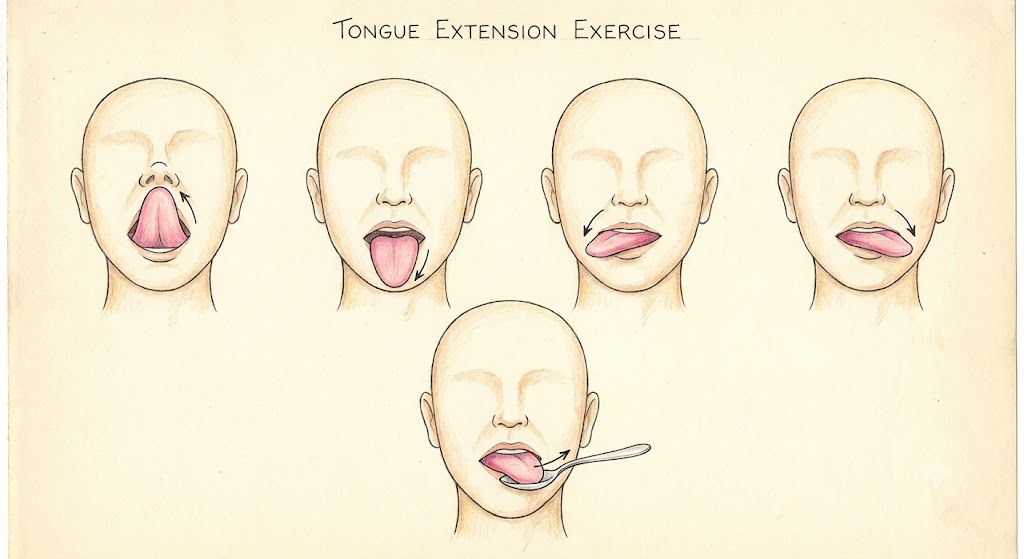
- Tongue Extension (The 'Extender' or 'Tongue Stretch'):
Stick your tongue out as far as you possibly can. Try to reach towards your nose, then your chin, then to the left, and finally to the right. Hold each position for about 5 seconds. Repeat this sequence three to four times. For an added challenge, you can try to touch your chin while looking up at the ceiling, holding for 10-15 seconds and gradually increasing the duration. You can also add resistance by pushing against a spoon with your tongue. - Tongue Against Roof of Mouth (The 'Lift' or 'Tongue Suction'):
Push your entire tongue firmly against the roof of your mouth. Try to suck it upwards, creating a suction effect. Hold this position for 5 seconds. Repeat this three times. A variation involves slowly opening your mouth while maintaining your tongue's position against the roof of your mouth. Looking upwards can make this exercise more challenging and engage your throat muscles more deeply.
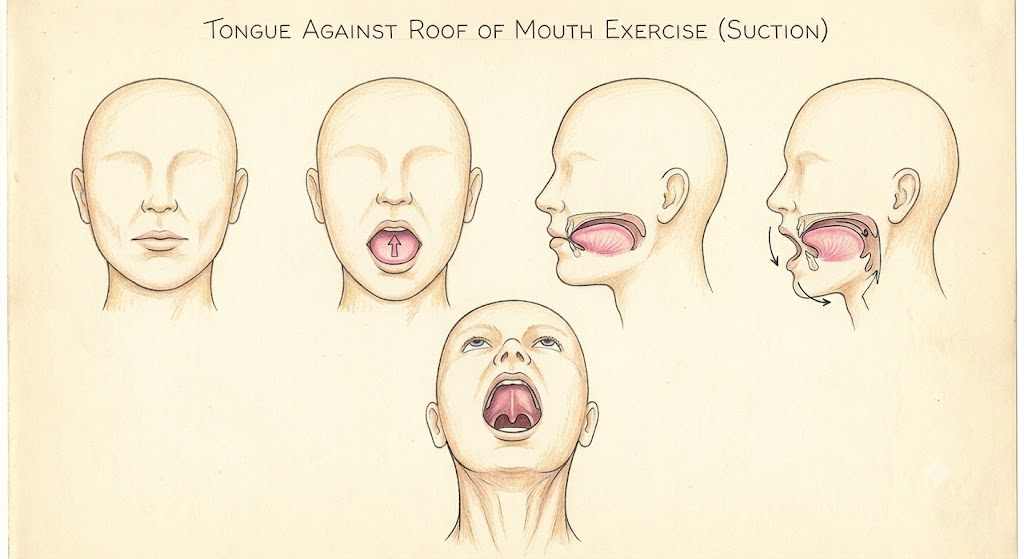
- Tongue Sliding:
Press the tip of your tongue against the roof of your mouth, just behind your front teeth. Slowly slide your tongue backward along the roof of your mouth as far as you can. Repeat this movement 20 times, several times daily. This helps strengthen your tongue and throat muscles. - Tongue Against Cheeks (Side-to-Side Push):
Push your tongue firmly into the inside of your left cheek, resisting with your left palm placed on the outside of your cheek. Hold for a few seconds. Then repeat on the right side, pushing your tongue into your right cheek and resisting with your right palm. Perform this two to five times on each side. This helps engage and strengthen the opposite cheek muscle. - Tongue Against Front Teeth and Swallow (The 'Teeth Push and Swallow'):
Push your tongue against your front teeth and then swallow. Repeat this three to five times. To make it harder and engage your throat muscles more deeply, try looking upwards while you do this. - Tongue Clench and Swallow:
Gently hold the tip of your tongue between your front teeth. While holding it, perform five swallows. Repeat this sequence five times. This helps strengthen the muscles involved in swallowing. - Tongue Curls:
Move the tip of your tongue backward towards your soft palate (the soft, fleshy part at the back of the roof of your mouth), stretching it as far as possible. Then, bring it forward to touch the back of your upper front teeth. Repeat this movement quickly 15 times. - Tongue Dropping:
Drop your tongue down the back of your throat as far as you can comfortably. Hold this position for 5 seconds. Repeat three times. This exercise helps strengthen the muscles of your palate.
Soft Palate and Throat Strengthening Exercises
- Gargling:
Gargle with water for 5 minutes, twice daily. This simple action helps to tone and stiffen the muscles of your soft palate. - Making 'Lah Lah Lah' Sounds:
Repeat the sound 'lah lah lah' five times. This helps to activate and strengthen the muscles at the back of your throat and soft palate. - Exaggerated Vowel Sounds:
Exaggerate the sounds of the vowels A-E-I-O-U, holding each sound for 5 seconds. This is a bonus exercise that helps to tighten the muscles in your throat. - Yawning:
Consciously yawn several times throughout the day. Yawning naturally stretches and strengthens the muscles in your throat and soft palate. - Making 'N-ga' Sounds:
Practice making 'n-ga' sounds, gradually combining them. This helps to work the muscles at the back of your throat. - Saying 'Ahhhhhhhh' (The 'Hippo'):
Open your mouth wide and say 'ahhhhhhhh' for 20 seconds. Repeat this once. This helps to strengthen the throat and jaw muscles. - High-Pitched Air Gargling (The 'Pitcher'):
Poke your tongue out and make a high-pitched air gargling noise for 30 seconds. This engages the throat muscles in a different way. - Slow, Controlled Swallows (The 'Boa'):
Perform five slow, controlled swallows, each lasting five seconds, while maintaining pressure in your throat. This helps to build endurance in your swallowing muscles.
Lip, Cheek, and Breathing Exercises
- Puffing Cheeks with Air:
Puff out your cheeks with air while breathing through your nose. Hold the air in your cheeks for 10 seconds. You can also try blowing out through a straw with a finger over the end for 5 to 10 seconds to create resistance. - Sucking Liquid Through a Straw:
Use a straw to suck liquid from one cup to another. This helps to strengthen the muscles involved in creating suction and maintaining a closed mouth. - Humming with Lips Together:
Hum with your lips gently together. Then, puff out your cheeks and say 'p' to release the air. Repeat this several times. - Lip Squeeze:
Press your lips firmly together. This helps to strengthen the muscles around your mouth, which can prevent your mouth from opening during sleep. - Cheek Suction:
Suck in your cheeks. This exercise also helps to strengthen the facial muscles. - Nasal Breathing Exercises (The 'Snorter' and 'Deep Sniffs'):
With your mouth closed and jaw relaxed, inhale deeply through your nose. Then, press one nostril closed with a finger and gently exhale through the other. This helps you identify and work on any congestion. For 'Snorters', take sharp nasal breaths rapidly in four sets of five repetitions, with a five-second break between sets. For 'Deep Sniffs', stick your tongue out and take long, deep nasal breaths 20 times. - Gum Chewing:
Chew gum with your mouth closed, making an 'mmmm' sound for 10 seconds. Repeat this five times. This strengthens your throat and jaw muscles. - Gulpers:
Perform ten consecutive forceful swallows with a closed mouth. This helps to strengthen the muscles involved in swallowing.
How Often and For How Long Should I Practice?
To achieve the best results, consistency is truly paramount. Think of these exercises as a daily routine, much like brushing your teeth. Many experts suggest performing these exercises for about 5 minutes each day, perhaps when you are already in the bathroom brushing your teeth, to help integrate them into your routine. Other recommendations include completing sessions 5 times daily in a relaxed environment, or performing two sets of exercises per session (totalling about 10 minutes) at least twice daily.
The key is to make them a regular part of your day. Neuromuscular re-education, which is the process of retraining your muscles, takes time and consistent effort. Don't worry if you miss a session occasionally, just pick up where you left off. Regular practice is crucial for strengthening these muscles and seeing improvements in your snoring.
Important Precautions and When to Seek Medical Advice
While snoring exercises are generally safe and beneficial, it's important to be aware of certain situations where you should consult a doctor. Snoring can sometimes be a symptom of a more serious condition called obstructive sleep apnoea (OSA). This is when your breathing repeatedly stops and starts during sleep.
You should speak to your doctor if your snoring is accompanied by any of the following symptoms:
- Episodes where you stop breathing during sleep (often reported by a partner).
- Choking or gasping for air during sleep.
- Excessive daytime sleepiness, even after a full night's sleep.
- Morning headaches.
- Difficulty with mood, concentration, or memory.
If you experience these symptoms, a comprehensive medical evaluation, including a 'sleep study,' may be necessary to confirm a diagnosis of OSA. If diagnosed with OSA, it's important to inform the DVLA (Driver and Vehicle Licensing Agency). These exercises are intended to complement, not replace, medical treatments for OSA.
In addition to exercises, lifestyle improvements can significantly help with snoring. These include:
- Changing your sleep position (e.g., sleeping on your side).
- Quitting smoking.
- Losing weight if you are overweight.
- Reducing alcohol intake, especially before bed.
- Avoiding sedatives.
If you have any concerns about structural issues in your nose or throat, or if you are already using a CPAP machine for OSA and are struggling with it, your doctor might refer you to an ENT (Ear, Nose, and Throat) specialist for further advice and guidance.
What to Expect: Progress and Results
The progress you make with snoring exercises can vary from person to person, but regular and consistent practice is the most important factor for success. Many studies, including a significant review of research from 2015, suggest that myofunctional therapy can reduce snoring and even sleep apnoea symptoms by approximately 50%.
You might not notice a difference immediately, but with consistent effort, you should start to experience improvements in the intensity and frequency of your snoring. The goal is to re-educate your muscles, helping them become stronger and more active during sleep. There are no significant complications or risks associated with these exercises, making them a safe option to try.
If you practice these exercises diligently for several weeks or months and do not notice any improvement, or if your symptoms worsen, please do not hesitate to contact your GP or ENT specialist. They can review your progress and discuss other potential solutions or further investigations.
Need Expert Advice?
Book a consultation with Mr Ahmad Hariri to discuss your symptoms and treatment options.
Book a Consultation